
Smart Inventory for Hospitals and Healthcare Facilities
Hospital staff spend too much time counting supplies and not enough time caring for patients. When inventory is managed by hand, things go missing, stockouts happen at the worst moments, and no one has a clear picture of what is actually on the shelf.
There is a better way to run supply management in clinical environments. Here is how smart inventory works in hospitals and healthcare facilities.
The hidden cost of manual inventory in healthcare
Manual inventory in a hospital is not just slow. It is a source of real, daily risk.
When nurses or supply staff count items by hand, errors creep in. Products expire unnoticed. High-value items disappear without a clear record of who took them or when. And when a critical supply runs out mid-shift, the scramble to find a replacement pulls staff away from patient care.
These are not rare edge cases. They are the everyday reality of running a ward, surgical suite, or sterile storage room without a reliable system in place.
The cost shows up in wasted staff hours, emergency orders, overstocking to avoid shortages, and the administrative burden of reconciling what was used against what was billed. None of that is where healthcare professionals want to spend their energy.
How RFID and NFC transform hospital supply tracking
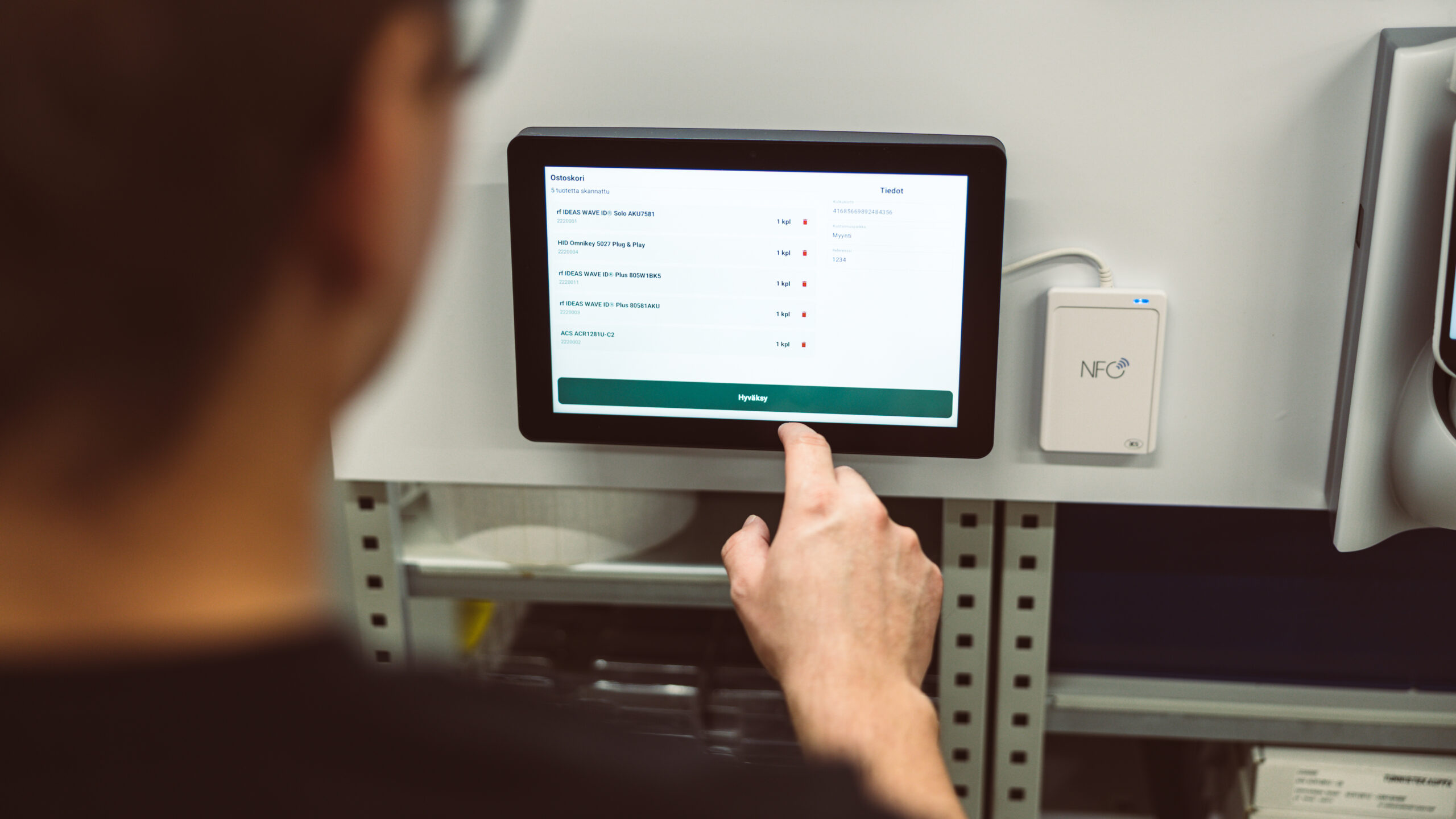
The core idea behind smart inventory is simple: every item in your storage gets a small tag that can be read automatically. No scanning guns. No clipboards. No manual entry.
When a product is taken from a smart cabinet, the system records it instantly. When stock drops below a set level, a replenishment alert goes out automatically. When you need to know what happened to a specific item, the record is already there.
Our smart cabinet can count up to a thousand items in ten seconds. That kind of speed turns a task that used to take an hour into something that happens in the background, without anyone lifting a finger.
For healthcare specifically, this matters in several high-stakes areas:
- Ward stock: Always know what is available on the floor, without relying on memory or manual checks
- Surgical supplies: Confirm item availability before a procedure, not during it
- Sterile inventory: Track expiry dates and usage automatically, reducing waste and compliance risk
- Narcotics auditability: Keep a clear, time-stamped record of who accessed what and when, supporting accountability at every step
Key benefits for hospitals and healthcare operations
Smart inventory is not about technology for its own sake. It is about giving healthcare teams more control and less friction in their daily work.
Here is what changes when a hospital moves from manual tracking to an automated system:
- Real-time stock visibility: See exactly what is available at any moment, from any location with access to the system
- Automatic replenishment: Orders go out when stock reaches a set threshold, so shortages become rare rather than routine
- Reduced shrinkage: Every item removal is logged, which discourages loss and makes discrepancies easy to spot
- Accurate cost allocation: Know which department used what, making billing and budgeting more straightforward
- Less administrative work: Staff spend less time counting and paperwork, and more time on what they were trained to do
The difference between the old way and the new way is significant. Here is a quick comparison:
- Manual ward process: Periodic counts, handwritten logs, reactive restocking, no clear audit trail, high risk of stockouts
- Smart cabinet approach: Continuous tracking, automatic alerts, proactive restocking, full audit history, consistent availability
If you are curious how similar principles apply to reducing inventory shrinkage in other sectors, the underlying logic is the same: visibility prevents loss.
Seamless integration with existing hospital systems
One of the most common concerns we hear is this: “Will it work with what we already have?” The answer is yes.
Our system connects to existing hospital management platforms and procurement systems through a standard interface. There is no need to replace your current software or overhaul your workflows. The smart cabinet fits into the environment you already operate in.
Setup is straightforward. Items are tagged, the cabinet is configured for your specific storage categories, and the system starts working. Your team does not need technical training to use it day to day.
We also support barcode-based setups for facilities that are not ready to move fully to tag-based tracking. The system is flexible enough to meet you where you are. For teams weighing different tracking approaches, our overview of barcode scanning options is worth a read.
Built on two decades of identification system expertise
We are Aksulit Oy, a software development company based in Laukaa, Finland. We have been building inventory and identification systems since 2003.
Over those two decades, we have worked across many industries and learned what makes a tracking system actually reliable in demanding environments. Healthcare is one of the most demanding there is, and we take that seriously.
Our smart cabinet solution is part of our Simple product family, designed specifically to bring clarity and control to complex storage environments. We are a small, experienced team, and when you work with us, you work directly with the people who built the system.
We do not claim medical-device certifications, and we do not need to. Our solution is a supply management tool that supports the people running clinical operations, not a regulated medical device. It is designed to fit into your facility, not to complicate it.
Start optimising your healthcare inventory today
If your team is still counting supplies by hand, the gap between where you are and where you could be is wider than you might think.
Our smart cabinet for healthcare gives you real-time stock visibility, automatic replenishment, and a clear record of every item movement. No more guesswork. No more stockouts during critical moments.
Getting started is straightforward. We assess your current setup, configure the system to match your storage categories and workflows, and support you through the transition. There is no need to change your existing hospital systems.
Ready to see what this looks like for your facility? Get in touch with our team and we will walk you through how it works in practice.
Or explore the Simple Cabinet solution to see the full picture before you reach out.