
Weight-based or RFID smart cabinet: which tracks stock more accurately?
When you choose a smart cabinet, the real question is simple: what do you need to know about each withdrawal? An RFID smart cabinet gives you item-level traceability. You see exactly which item left, who took it and when it came back. A weight-based smart cabinet suits consumables that are not worth tagging one by one, such as screws, gloves or small fittings.
Neither is better in every case. This guide walks through how each one tracks stock, where each can slip up, and how to match the cabinet to what you store. By the end, you should be able to pick with confidence.
Real-World Accuracy: Weight Sensors vs RFID Readers
Smart cabinet stock accuracy depends on what the cabinet actually measures. One counts individual items. The other estimates a count from weight.
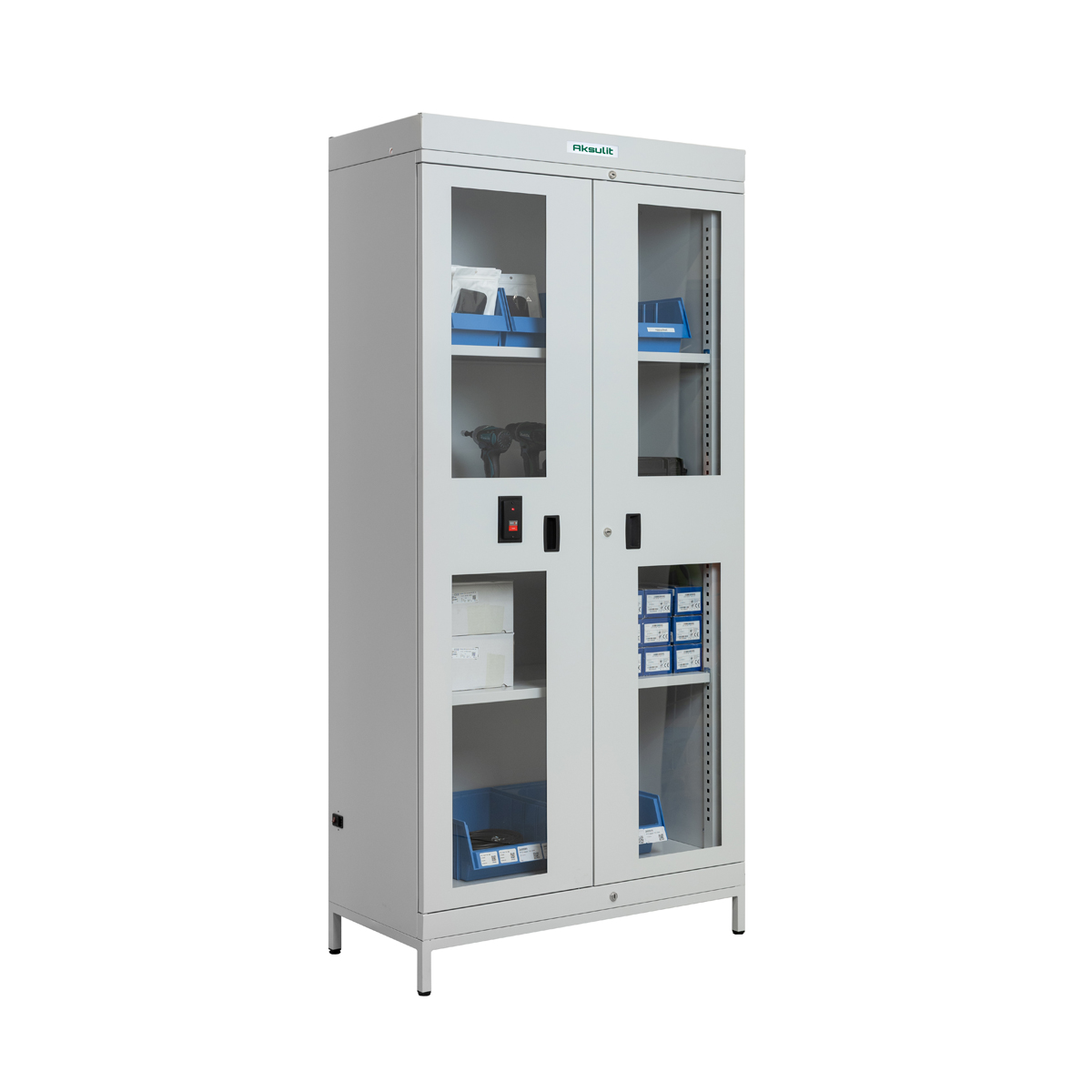
An RFID cabinet works like a very fast, very careful stock-taker. Every product carries its own tag, so the cabinet knows each one by name. Our Simple Cabinet RFID inventories up to 1,000 products in 10 seconds. It logs what is taken and returned, and it opens only with a personal tag, so every withdrawal is tied to a person.
A weight-based cabinet works more like a shop scale. It knows how much a shelf should weigh, notices when that changes, and works out how many items were removed. Users identify themselves with an NFC key fob or tag. The cabinet then updates stock and raises replenishment requests on its own.
Here is the key difference in plain terms:
- RFID: tells you which exact item was taken.
- Weight: tells you how many of a product type were taken.
If you want a gentle primer on the basics first, our guide to how a smart cabinet works in a warehouse covers the ground.
Where Each Technology Loses Accuracy
Every method has a weak spot. Knowing it in advance saves you from nasty surprises later.
Weight-based tracking
Weight counts rely on every item of a type weighing the same. That works well for uniform products. It gets shakier when items vary, or when someone puts the wrong product on the wrong shelf. A returned item that is different from what was taken can also confuse the count.
Weight also cannot tell you which specific item was removed. If two similar products share a shelf, the cabinet may know something left but not exactly what.
RFID tracking
RFID is only as good as the tagging. An item without a tag is invisible to the cabinet. If someone forgets to tag a new delivery, the cabinet will not count it.
Tags also add a small job to your goods-in routine. Someone must attach them. That is easy to build into a process, but it needs to happen every time.
The pattern is simple. Weight can blur the detail. RFID can miss anything left untagged.
Matching Technology to Your Item Types
The best way to choose is to look at what you actually store. Think about value, variety and how much you care about each individual item.
RFID fits items that are:
- Expensive or critical, such as precision tools or spare parts
- Different from one another, even if they look similar
- Required to be traced back to a specific person
Our article on an RFID smart cabinet for industrial tools and spare parts shows this in a working setting.
Weight-based tracking fits items that are:
- Cheap and bought in volume, such as fasteners, seals or consumable supplies
- Identical within each product type
- Not worth the effort of tagging individually
One important limit applies to both. Neither cabinet is temperature-controlled or fire-protected. That rules out perishable food, and it means they are not suitable for charging batteries. Keep those items elsewhere.
Cost, Maintenance, and Calibration Trade-Offs
The two options ask for different kinds of effort. Neither is hard, but it helps to know where your time will go.
With a weight-based cabinet, you save on tags. Products need no individual labelling, which keeps day-to-day handling light. In return, you should expect to set up the shelves carefully and check them now and then. Weight settings need to match the products stored, so changing what sits on a shelf means updating the setup.
With an RFID cabinet, the effort moves to the tags. You buy them and attach them. Once that routine is in place, the cabinet does the counting itself and the setup stays steady, even when you move items around.
A few questions help here:
- How many items pass through each month?
- How cheap is each item compared with a tag?
- Who would handle tagging or shelf setup?
If your stock is high-value and varied, tagging usually pays for itself in clarity. If your stock is low-value and uniform, skipping the tags keeps things simple.
Choosing Between Weight-Based, RFID, or Hybrid
Start with one question: what do you need to know about each withdrawal? If the answer is “exactly which item, and who took it”, choose RFID. For precise traceability, we recommend Simple Cabinet RFID.
If the answer is “just keep me stocked, and alert me when we run low”, a weight-based cabinet is a good fit. Simple Cabinet Scale handles the counting and sends replenishment requests automatically, with no tags on the products.
Many sites do not have to choose just one. A hybrid setup is common. You might keep valuable tools in an RFID cabinet and everyday consumables in a weight-based one. Both report to Simple Cloud in real time, so you see everything in one place.
A few practical notes before you order:
- Existing access tags can often be reused, as long as their details are known before ordering.
- Decide first which items need tracing and which only need topping up.
- If you are curious about the technology behind tagging, see how RFID inventory management works.
Still unsure which mix suits your storeroom? We are happy to talk it through. Get in touch with us and we will help you find the right fit.