
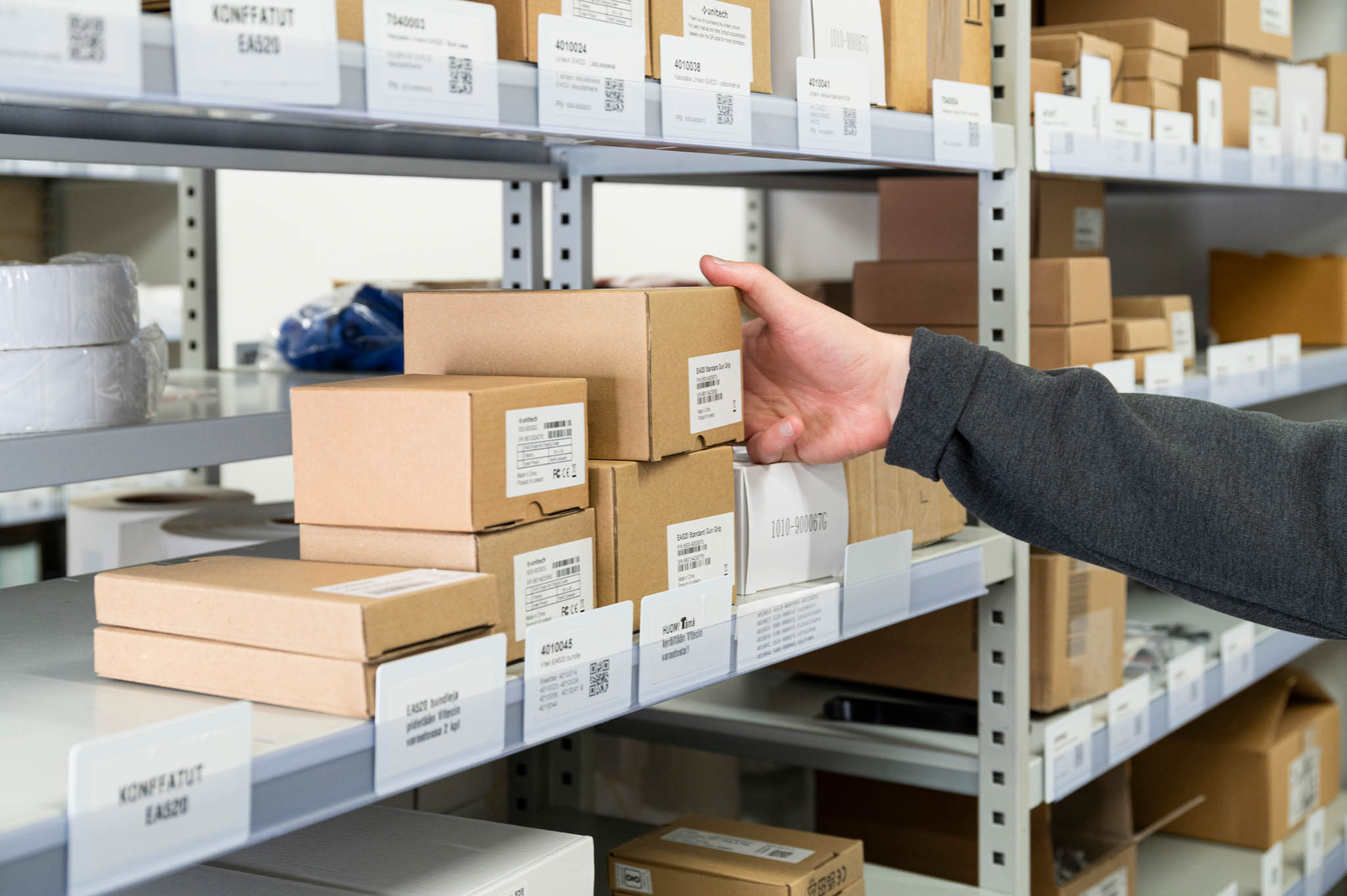
Real-Time Stock Visibility Across the Supply Chain
Knowing what you have in stock, where it is, and when it moves sounds simple. In practice, it is one of the hardest problems in modern supply chain management. Products change hands across warehouses, vehicles, job sites, and retail floors. At each handoff, there is a chance that information will lag behind reality. When it does, decisions are made based on outdated data, and the consequences range from empty shelves to costly overstock.
Real-time stock visibility changes that equation. Instead of discovering problems after the fact, companies can see what is happening across their supply chain as it happens. This article explains why visibility is so difficult to achieve, what it looks like when it works, and how modern tools make it possible. If you want to see how this works in practice, explore the Simple product family as a starting point.
Why supply chains struggle with stock visibility
Most supply chain problems are not caused by a lack of effort. They are caused by a lack of shared, accurate information. Each part of the chain, from the supplier to the warehouse to the end customer, tends to keep its own records. Those records are updated at different times, in different formats, and by different people. The result is a patchwork of partial truths rather than a single clear picture.
Manual processes make this worse. When stock movements are recorded by hand, on paper or in spreadsheets, there is always a gap between when something happens and when it gets written down. That gap might be an hour, a day, or longer. During that time, anyone checking the system sees a version of reality that no longer exists.
Fragmented systems add another layer of difficulty. A company might use one system for purchasing, another for warehouse operations, and a third for sales. If these systems do not communicate with each other automatically, someone has to transfer data between them manually. That creates more opportunities for errors and delays. The more links in the chain, the more places information can get lost or distorted.
There is also a human factor. People are busy. Logging every product movement accurately and consistently requires discipline, and in a fast-moving warehouse environment, shortcuts happen. A product gets moved without being scanned. A return gets placed on the wrong shelf. Small inaccuracies accumulate until the system’s numbers and the physical reality no longer match.
What real-time visibility actually means in practice
Real-time visibility means that whenever a product moves, the system knows immediately—not at the end of the shift, not after a weekly stock count, but right away. Anyone with access to the system can see current stock levels, recent movements, and who handled what and when.
This is more than just a technical feature. It changes how decisions are made. A purchasing manager can see that a fast-moving item is running low and place a replenishment order before the shelf goes empty. A warehouse supervisor can spot that a product has not moved in weeks and flag it for review. A field technician can check whether a spare part is available before driving to the depot.
What good visibility looks like day to day
In a well-connected warehouse, visibility shows up in small but meaningful ways. Stock counts that used to take hours happen in seconds. Discrepancies between what the system says and what is physically on the shelf become rare rather than routine. Replenishment happens based on actual usage patterns rather than guesswork.
Visibility also means accountability. When every product movement is logged automatically, it is easy to see who took what and when. This reduces shrinkage, simplifies audits, and makes it much easier to trace a problem back to its source. The data trail is not just useful for operations; it becomes a foundation for planning, forecasting, and continuous improvement.
It is worth being clear about what real-time visibility is not. It is not simply having a warehouse management system installed. Many companies have systems that are technically capable of real-time tracking but are not set up or used in a way that delivers it. Technology is only part of the answer. Processes, people, and integrations between systems all have to work together.
Technologies enabling live inventory tracking today
Several technologies have made live inventory tracking genuinely practical for businesses of many sizes. Each has different strengths, and the right choice depends on what a company is tracking, how it moves, and how much automation is needed.
Barcode scanning is the most familiar approach. It is low-cost, widely understood, and works well when products move in predictable ways through defined checkpoints. The limitation is that scanning requires a person to point a device at each item. It works, but it does not eliminate the human step.
Automatic identification without manual scanning
More advanced systems use radio-frequency identification, commonly known as RFID, to track products without requiring line-of-sight scanning. A small tag attached to each item communicates with a reader automatically when it passes through a certain area. This means an entire trolley of products can be logged in seconds without anyone scanning each one individually. Systems built on this approach can process a thousand items in under ten seconds, making it practical for high-volume environments.
A related technology uses near-field communication, or NFC, for shorter-range identification. NFC is particularly useful for user authentication, such as confirming who entered a storage area, and for individual item tracking in controlled spaces. Combined with automatic scanning at entry and exit points, it creates a complete picture of who accessed what and when.
Mobile applications bring inventory management out of the back office and into the hands of the people doing the work. A warehouse operative with a handheld device can receive goods, move stock between locations, and run a stock count without returning to a fixed terminal. When the app works offline as well as online, it remains useful even in areas with poor connectivity.
Connecting the pieces
The real power comes when these technologies feed into a central system that integrates with other business software. When the warehouse management system shares data automatically with purchasing, sales, and finance systems, the whole organisation works from the same picture. Replenishment orders can be triggered automatically when stock drops below a set level. Invoicing can reflect actual deliveries rather than planned ones. Reporting becomes a matter of looking at a dashboard rather than compiling spreadsheets.
Key factors in successful supply chain integration
Technology alone does not deliver visibility. The way systems are connected and the quality of the data flowing between them matter just as much as the tools themselves. Companies that get integration right share a few common practices.
The first is starting with clean data. If the product catalogue is inconsistent, if items have duplicate entries, or if information is missing, the new system will inherit those problems. Taking time to clean up master data before an integration goes live prevents a lot of confusion later.
Design for the people using it
Integration projects sometimes focus so much on the technical side that the user experience gets neglected. If the system is difficult to use, people will find workarounds, and those workarounds undermine the accuracy of the data. The best systems are designed so that doing the right thing is also the easiest thing. Scanning a product should take one step, not three. Logging a stock movement should happen automatically wherever possible, not require a separate entry.
Training matters too, but it should not need to be extensive. If a system requires days of training before someone can use it confidently, that is usually a sign that the design needs work. Well-designed systems can be learned quickly and used reliably by people who are focused on their actual job, not on operating software.
Another key factor is deciding which systems need to share which data. Not every integration is worth building. The most valuable connections are usually between the warehouse management system and purchasing or replenishment on one side, and sales or service operations on the other. These are the connections that turn stock data into business decisions.
Finally, integrations need to be maintained. Systems change over time. Suppliers update their platforms, internal tools get replaced, and business processes evolve. An integration that works well at launch can quietly break over time if no one is responsible for keeping it current. Assigning clear ownership of the integration layer is a small step that prevents large problems later.
A strategic approach to visibility across supply chain tiers
Most discussions of supply chain visibility focus on a single warehouse or a single company. But the real challenge—and the real opportunity—is visibility across multiple tiers. That means seeing not just what is in your own warehouse, but what is moving between your suppliers, your distribution points, and your customers.
This kind of end-to-end visibility is harder to achieve because it requires cooperation between organisations, not just within one. Each party in the chain has its own systems, its own priorities, and its own definition of what data is worth sharing. Building visibility across these boundaries takes both technical and organisational effort.
Starting with the highest-value connections
A practical approach is to start where the pain is greatest. For many companies, that means the connection between the warehouse and the field. Field teams that cannot see stock levels remotely make unnecessary trips or carry too much inventory as a buffer. Giving them live access to stock data through a mobile app or a simple web portal can reduce wasted time and improve service levels without requiring a full end-to-end transformation.
Another high-value starting point is the supplier relationship. When a supplier can see your stock levels directly, it can anticipate your needs rather than waiting for a purchase order. This shortens lead times and reduces the risk of running out. It requires trust and a degree of data sharing that not every supplier relationship is ready for, but where it works, the benefits are significant.
Visibility across tiers also changes how companies think about safety stock. When you can see demand signals earlier and respond faster, you do not need to hold as much buffer inventory. That frees up cash and storage space. It also reduces the risk of holding stock that becomes obsolete or expires before it is used.
The long-term goal is a supply chain where information moves as fast as goods do. That is not a single project. It is a direction of travel, and every step toward better visibility—whether it is a new scanning system, a better integration, or a cleaner data process—moves the whole operation closer to that goal.
How Aksulit Oy helps companies achieve real-time stock visibility
Aksulit Oy is a Finnish software company based in Laukaa, near Jyväskylä, with more than two decades of experience building inventory and identification systems for businesses across different industries. The company specialises in smart warehouse solutions that give organisations a clear, live picture of their stock at all times.
Their flagship product family, Simple, covers the full range of inventory management needs. The key tools include:
- Simple Storage — an automated smart cabinet system that logs every product movement instantly, identifies users at entry, and updates stock levels in real time without any manual scanning
- Simple Pocket — a mobile warehouse management application for receiving, picking, transferring, and counting stock directly from a phone or handheld device, with offline capability for areas without connectivity
- Automatic replenishment alerts that trigger when stock drops below a set threshold, so ordering happens based on actual usage rather than periodic checks
- User-level tracking that records who took what and when, supporting accountability and cost allocation
- Integration with existing business systems, so stock data flows automatically into purchasing, sales, and finance without manual data transfer
The system can process up to a thousand products in ten seconds, making it practical for busy environments where speed matters. It works across a wide range of settings, from industrial maintenance stores and tool rooms to technical wholesale and equipment rental operations. Because the Simple products are designed to work together and connect to other systems through standard interfaces, companies can start with what they need now and expand as their requirements grow.
Aksulit Oy also provides consulting support, helping customers choose the right solution for their specific situation rather than applying a one-size-fits-all approach. Discover the full Simple product family to see how each tool fits together, or get in touch with the Aksulit team to discuss what real-time stock visibility could look like for your operation.