
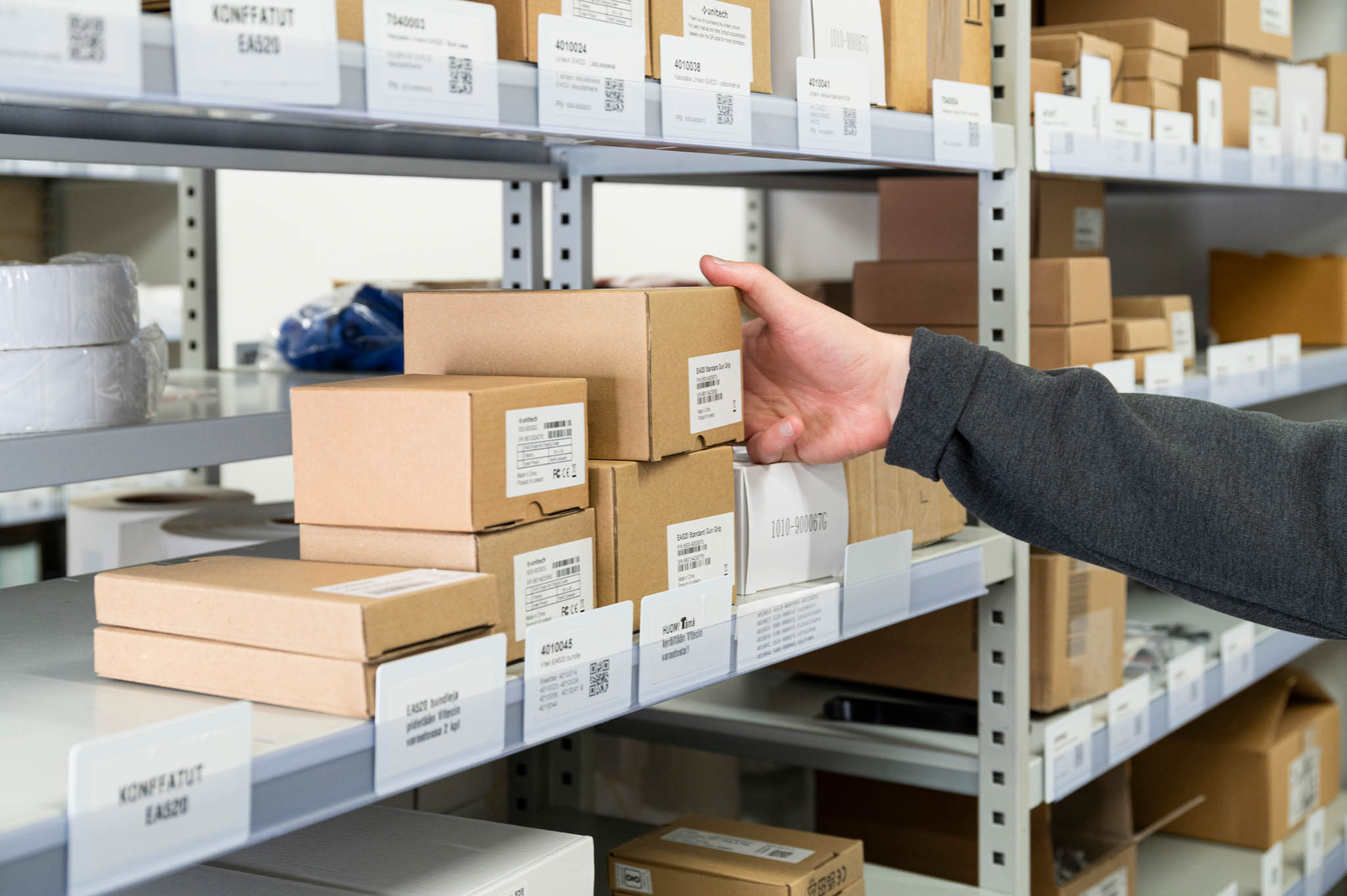
Smart Warehouse Solution for Maintenance and MRO Operations
Maintenance and MRO operations depend on parts availability. When a technician needs a specific component to keep a production line running, every minute spent searching for that part is a minute of potential downtime. Yet despite how critical parts availability is, many maintenance storerooms still rely on manual counts, paper logs, and gut instinct to manage inventory. The result is a familiar cycle of overstocking, stockouts, and wasted time. A well-designed smart warehouse solution breaks that cycle by giving maintenance teams accurate, real-time visibility into what they have, where it is, and when to reorder.
This article walks through the specific challenges of MRO inventory management, what poor visibility actually costs, how modern smart storage technology works in practice, and what to look for when choosing a solution. If you are already exploring options, Simple Storage by Aksulit Oy is a smart warehouse system built specifically for these use cases.
Why MRO inventory management is uniquely complex
MRO stands for Maintenance, Repair, and Operations. It covers a wide range of supplies, spare parts, tools, and consumables that keep equipment and facilities running without being part of the finished product. This category is notoriously difficult to manage well, and for good reason.
Unlike production materials, MRO demand is irregular and hard to predict. A bearing might sit untouched for months and then be needed urgently several times in a single week. Consumption patterns do not follow seasonal trends or production schedules in any reliable way, which makes traditional forecasting methods far less effective for maintenance supplies than for manufacturing inputs.
The sheer variety of items adds another layer of difficulty. A typical maintenance storeroom may hold thousands of distinct items, ranging from small fasteners and lubricants to large mechanical components and specialist tools. Each item may come from a different supplier, have a different shelf life, and be used across multiple departments or shifts. Tracking all of this manually is time-consuming and prone to error.
There is also the issue of accountability. In production environments, materials are issued against work orders and tracked carefully. In many maintenance storerooms, parts are taken informally — especially during urgent repairs — and records are updated later, or not at all. Over time, this creates a growing gap between what the system shows as in stock and what is actually on the shelf.
What poor parts visibility costs maintenance operations
The most obvious cost of poor maintenance warehouse management is unplanned downtime. When a technician cannot find a part, or the system shows stock that no longer exists, repairs are delayed. In industrial settings, even short delays can translate into significant production losses.
Beyond downtime, there are several less visible but equally real costs worth considering.
- Emergency purchasing: When standard stock appears unavailable, teams often resort to urgent orders at premium prices — sometimes for items that are actually in stock but cannot be located.
- Overstocking: Without reliable visibility, buyers hedge by ordering extra. This ties up capital in slow-moving inventory and creates unnecessary storage pressure.
- Shrinkage and loss: Items that are not tracked properly tend to disappear. Some are used without being recorded, others are misplaced, and some are simply taken without authorisation.
- Administrative burden: Manual stock counts, reconciliation work, and chasing down usage records consume maintenance staff time that could be spent on actual maintenance work.
- Compliance gaps: In regulated industries, being unable to demonstrate who used what and when can create audit and liability issues.
The combined effect of these costs is often larger than it appears on the surface. Organisations that have moved from manual to automated inventory management for MRO frequently find that savings in emergency purchasing and staff time alone justify the investment, even before factoring in any reduction in downtime.
How RFID and NFC technology work in smart warehouse environments
At its core, a smart warehouse system works by giving every item a unique digital identity and then automatically recording when items are added to or removed from storage. The technology behind this is straightforward once you strip away the jargon.
Each item, or its storage location, carries a small tag. When items are moved, a reader detects the tag and records the transaction automatically. No one needs to scan anything manually or update a spreadsheet — the system simply knows. This is the fundamental shift that makes warehouse automation genuinely useful in maintenance environments: it removes the dependency on human data entry, which is where most errors and gaps occur.
The two most common technologies used in smart maintenance storage are RFID (Radio Frequency Identification) and NFC (Near Field Communication). Both work by transmitting data wirelessly between a tag and a reader. RFID is typically used for bulk scanning over greater distances, while NFC is suited to close-range, item-by-item interactions. In practice, many smart warehouse systems combine both to handle different storage configurations and use cases within the same operation.
What this looks like in practice
In a smart maintenance storeroom, a technician opens a cabinet to take a replacement valve. The system detects what was removed, updates the stock count instantly, and checks whether the remaining quantity has dropped below the reorder threshold. If it has, a replenishment request is triggered automatically. The whole process takes no extra time for the technician and generates no paperwork.
For managers and planners, this means the inventory data they see is current and accurate at all times. There is no waiting for the next manual count, no reconciling discrepancies, and no guessing. Usage patterns become visible over time, making it easier to set sensible reorder points and avoid both stockouts and excess inventory.
Speed and scale
One practical advantage of this approach is how quickly inventory can be assessed. Systems designed for dense storage environments can read and identify large numbers of items in seconds, making full stock checks a routine background task rather than a periodic disruption. This is particularly valuable in maintenance settings where storage units often hold hundreds of small, similar-looking items that are time-consuming to count by hand.
Key factors in evaluating a smart warehouse solution for MRO
Choosing the right smart storage system for a maintenance environment involves more than comparing feature lists. The operational context of MRO work creates specific requirements that not every system handles equally well.
Before evaluating individual products, it is worth mapping out your own operation’s priorities. The following factors tend to matter most in maintenance and MRO settings.
A structured comparison can also help clarify trade-offs between different approaches. The table below outlines how manual, basic digital, and smart warehouse systems typically differ across the criteria that matter most to maintenance operations.
| Criterion | Manual tracking | Basic digital system | Smart warehouse system |
|---|---|---|---|
| Stock accuracy | Low — depends on consistent human entry | Moderate — requires manual updates | High — updated automatically at point of use |
| Replenishment | Manual, often reactive | Semi-automated with manual triggers | Automatic, threshold-based |
| Traceability | Limited or absent | Partial — tied to data entry discipline | Full — every transaction recorded automatically |
| Staff time required | High — counts, reconciliation, paperwork | Moderate | Low — minimal interaction required |
| Integration with CMMS/ERP | None | Varies — often requires manual export | Typically available via API |
| Scalability | Poor | Moderate | Good — modular systems can grow incrementally |
Fit with maintenance workflows
A system that works well for a retail stockroom may not suit a maintenance storeroom where access is needed around the clock, items are taken urgently during breakdowns, and the same part may be used across multiple assets or work orders. Look for solutions that support unplanned usage, allow for easy exception handling, and do not create friction during time-sensitive repairs.
Integration with existing systems
Most maintenance operations already use a computerised maintenance management system (CMMS) or an enterprise resource planning (ERP) platform. A smart warehouse solution should integrate cleanly with these systems so that parts usage is linked to work orders and asset history without requiring double entry. Seamless data flow between systems is what turns inventory data into actionable maintenance intelligence.
Ease of use for frontline staff
Technicians and maintenance workers are not warehouse professionals. The simpler the interaction with the system, the more consistently it will be used. Solutions that require minimal training and fit naturally into how maintenance staff already work tend to deliver better data quality over time.
Scalability and flexibility
Maintenance storerooms evolve. New equipment brings new parts requirements, operations expand, and storage needs change. A good system should be able to grow with the operation without requiring a full replacement or significant reconfiguration. Modular solutions that can be expanded incrementally are generally a better long-term fit for industrial maintenance environments.
Reporting and visibility
Real-time stock levels are the baseline. Beyond that, useful reporting should show usage trends by item, by technician, and by asset or work order. This kind of visibility supports better planning, helps identify waste, and provides the data needed for cost allocation across departments or projects.
A strategic approach to smart warehouse implementation
Implementing a smart warehouse system in a maintenance environment is not primarily a technology project. It is a change in how people work, how information flows, and how decisions are made. Approaching it strategically from the start makes a significant difference to the outcome.
A useful starting point is a clear assessment of the current state. Which items cause the most problems? Where do stockouts happen most often? Which parts are consistently overstocked? Where does manual tracking break down? This kind of baseline analysis helps prioritise where automation will have the greatest impact and lays the foundation for measuring improvement.
From there, a phased approach tends to work better than trying to automate everything at once. Starting with the highest-value or highest-risk items — such as critical spare parts or frequently used consumables — allows the team to learn the system and build confidence before expanding the scope. It also delivers visible results quickly, which helps build internal support for the broader change.
Staff involvement matters more than most people expect. The technicians and storeroom staff who interact with the system daily will determine whether it works well or poorly in practice. Involving them early, explaining the rationale, and acting on their feedback during setup leads to better adoption and better data quality over time.
Finally, the system should be connected to existing maintenance and procurement processes from the start, not added as a separate layer. When stock levels, usage history, and replenishment triggers are integrated with work order management and supplier ordering, the full value of the investment becomes visible. A phased implementation might follow a sequence such as this:
- Audit current inventory and identify the highest-priority items and problem areas.
- Define reorder thresholds and usage categories for the initial scope.
- Deploy smart storage hardware and configure the software for the priority items.
- Connect the system to existing CMMS or ERP platforms via API.
- Train frontline staff and run a short parallel period to validate data accuracy.
- Review results, refine thresholds, and expand the system to additional storage areas.
How does Aksulit Oy help MRO and maintenance teams with smart warehousing?
Aksulit Oy is a Finnish software company that has been developing inventory and identification systems since 2003. Based in Laukaa, near Jyväskylä, the company specialises in smart warehouse solutions that bring real-time visibility and automated stock management to industrial and maintenance environments.
Their flagship product for this use case is Simple Storage, a smart warehouse system designed to eliminate manual stock tracking and keep maintenance supplies available without unnecessary effort. The system uses RFID and NFC technology to track every item automatically. Key capabilities include:
- Automatic stock updates every time an item is taken or returned
- Real-time inventory visibility so the current stock level is always accurate
- Automatic replenishment triggers when stock falls below defined thresholds
- Full traceability showing who took what and when, supporting cost allocation and compliance
- Integration with existing ERP and CMMS systems through a standard API connection
- Inventory scanning capable of processing a large number of items in seconds
For maintenance teams managing large numbers of small parts and consumables, Aksulit Oy also offers the Simple Cabinet for compact storage units and the Simple Pocket for mobile or field-based MRO needs. The company supports customers throughout the entire process, from initial consultation through integration and ongoing use.
If your maintenance operation is dealing with stockouts, excess inventory, or time lost to manual tracking, Aksulit Oy offers a practical and proven path forward. Get in touch with the Aksulit team to discuss your specific situation and find out how a smart warehouse solution could work for your operation. You can also explore Simple Storage to learn more about the system and its capabilities.